
Review and Publication Process
The Asian Educational Therapist operates a double-anonymised peer review process for all submitted manuscripts. Manuscripts are reviewed by at least two independent expert reviewers. The identities of authors and reviewers are concealed from each other throughout the review process. Editorial decisions are made solely on the basis of scientific merit, originality, and relevance, independent of author characteristics such as nationality, institutional affiliation, or seniority.
All editorial decisions are made independently of commercial, financial, or personal considerations. Members of the Editorial Board who submit manuscripts to the journal are subject to the same peer review process as all other authors and are excluded from all editorial decisions relating to their own submissions. Read Editorial Independence Policy.
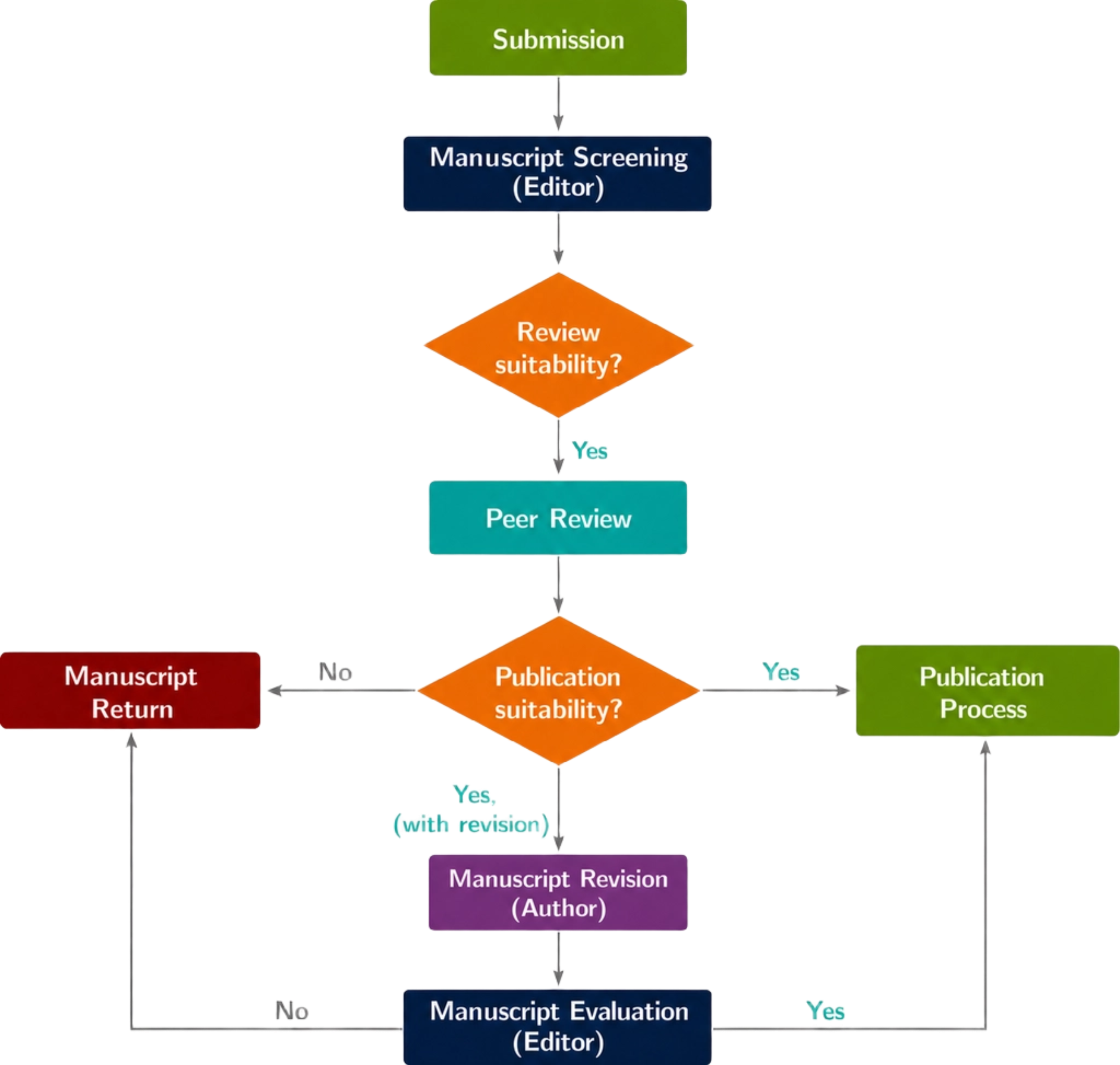
Stage 1 - Submission and Initial Screening
Upon receipt, every submission undergoes an initial editorial screening within 5 business days. This screening checks that:
● The manuscript falls within the journal's Aims and Scope
● The manuscript file is fully anonymised (no author-identifying information)
● The Title Page is complete with all required declarations
● The submission complies with the formatting and word count requirements set out in the Author Guidelines
● The applicable reporting guideline checklist (e.g., CONSORT, PRISMA, STROBE, CARE, SANRA) has been submitted as a supplementary file where required
All manuscripts are screened for plagiarism using Crossref Similarity Check (iThenticate) at this stage. Manuscripts above the acceptable similarity threshold are returned to the author without proceeding to peer review.
Manuscripts that do not meet the above requirements will be returned to the corresponding author with a request to resubmit in conforming format. This does not constitute a rejection decision.
Manuscripts that pass initial screening are forwarded to an editor for a second-level editorial assessment of scientific merit and suitability for peer review.
Stage 2 - Reviewer Selection
Reviewers are selected on the basis of subject-matter expertise relevant to the manuscript's topic, methodology, and clinical or educational context. The editorial team identifies reviewers from the following sources:
● The journal's pool of registered, external reviewers
● Author-recommended reviewers (subject to editorial discretion; the journal is not obligated to use recommended reviewers)
● Suitably qualified experts identified through the published literature in the relevant field
Reviewers with any actual or perceived conflict of interest with the authors or the manuscript content are excluded. At least two independent expert reviewers are assigned to every manuscript. A third reviewer may be appointed where reviewer opinions diverge significantly or where specialist statistical or methodological expertise is required.
Reviewers are required to declare any conflict of interest upon accepting an invitation to review and to maintain full confidentiality of the manuscript and its contents.
Stage 3 - Peer Review
Reviewers are asked to complete their review within 3 to 4 weeks of accepting the invitation. Reviewers evaluate the manuscript against the journal's Content Quality Standards (as set out in the Author Guidelines) and provide:
● Detailed written comments and suggestions to the authors
● A recommendation to the editor: Accept, Minor Revision, Major Revision, or Reject
Reviewers submit their evaluations using the journal's standardised Review Form. Review reports are shared with the corresponding author in full, with reviewer identities withheld.
Where a manuscript involves quantitative data analysis, the editor may appoint a statistical reviewer to assess the appropriateness and accuracy of the statistical methods used.
Stage 4 - Editorial Decision After Peer Review
The Editor-in-Chief or handling editor reviews all referee reports and makes one of the following decisions, communicated to the corresponding author typically within 1 to 2 weeks of receipt of all reviewer reports:
|
Decision |
Meaning |
|
Accept |
The manuscript is accepted for publication as submitted or with only minor copyediting. |
|
Minor Revision |
The manuscript requires limited revisions. Authors are given 2 weeks to resubmit. |
|
Major Revision |
The manuscript requires substantial revision and will be re-reviewed. Authors are given 4 weeks to resubmit. |
|
Reject |
The manuscript does not meet the journal's standards and will not be considered further. |
The editorial decision letter will include the full reviewer reports and, where a revision is invited, specific guidance on the revisions required.
Stage 5 - Revised Manuscript Submission
Authors submitting a revised manuscript must include a Response to Reviewers document detailing, point by point, how each reviewer comment has been addressed. Changes to the manuscript should be clearly indicated (e.g., using tracked changes or a list of changes with page and line references).
● Minor revisions are assessed by the editor and do not ordinarily require a return to the original reviewers.
● Major revisions are returned to at least one of the original reviewers, and may be sent to additional reviewers if new content has been introduced.
If the revised manuscript adequately addresses all reviewer concerns, the editor will issue an acceptance decision. If further revision is still required, authors will be notified with a second round of specific comments. A manuscript that fails to adequately address reviewer concerns after two rounds of revision may be rejected.
Stage 6 - Acceptance and Production
Upon final acceptance, the corresponding author will receive an acceptance notification. The manuscript then enters the production stage, which includes:
● Copyediting for language, formatting, and compliance with journal style
● Typesetting and layout
● Assignment and registration of the article DOI with CrossRef
● Author proof review (authors are given 5 business days to review and return the proof)
● Online publication
The journal operates continuous publication within each issue. Accepted articles are published online as soon as production is complete, without waiting for the full issue to be finalised.
Stage 7 - Indicative Turnaround Time
These are indicative timeframes. Actual timelines may vary depending on reviewer availability and the complexity of revisions required.
|
Stage |
Indicative Timeframe |
|
Initial screening decision |
Within 5 business days of submission |
|
First decision after peer review |
4 to 8 weeks from submission |
|
Author revision period (minor) |
2 weeks |
|
Author revision period (major) |
4 weeks |
|
Final acceptance to online publication |
2 to 4 weeks |
Submission, acceptance, and publication dates are recorded and displayed for all articles published from Volume 3 Issue 3 (2025) onwards, coinciding with the journal's adoption of a fully systematic editorial management system. Dates for articles published in Volumes 1 (2023) to 3 Issue 2 (2025) reflect the issue publication date only.
Stage 8 - Appeals
Authors who wish to appeal a rejection decision may do so within 30 days of the decision notification. Appeals must be submitted in writing to the editorial office and must state specific grounds, such as:
● A demonstrable factual or methodological error in a reviewer's assessment
● Evidence of an undisclosed conflict of interest on the part of a reviewer
● Evidence that the manuscript was assessed outside its stated scope
Disagreement with a reviewer's scholarly judgement does not constitute grounds for appeal. The Editor-in-Chief will review the appeal and may consult an independent expert. The Editor-in-Chief's decision on appeal is final.
See Complaints and Appeals Policy
Stage 9 - Reviewer Misconduct
Any suspected breach of reviewer confidentiality, plagiarism of submitted manuscripts, or other reviewer misconduct will be investigated in accordance with COPE guidelines. Authors who suspect reviewer misconduct should contact the editorial office in writing with supporting evidence.
Related Policies
Reviewer Guidelines and Policy · Author Guidelines · Editorial Independence Policy · Complaints and Appeals Policy · Plagiarism Policy